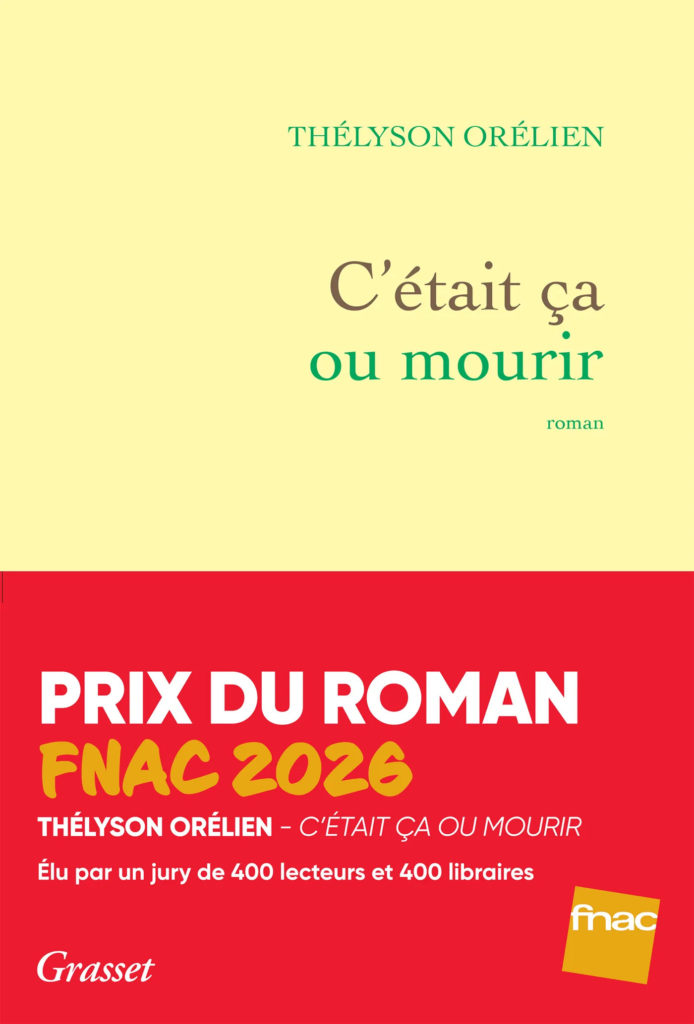
Thélyson Orélien is a 38-year-old writer, born in Gonaïves, Haiti, and living in exile in Canada for fourteen years. On Monday, September 21, in Paris, a jury (composed of 400 readers and 400 booksellers) awarded him the Fnac Novel Prize for his first work “C’était ça ou mourir” (published by Grasset on August 19 – 272 pages).
Previously, on August 25, 2026, the book received the Strasbourg Espoir CIC Prize. On July 30, 2026, the Méduse Prize was awarded to Orélien. On August 31, 2026, he was also the winner of the Première Plume Prize.
In “C’était ça ou mourir” (It Was Either That or Die), the author recounts the long journey of his character, Jonas Dorléon, a history teacher, from the Caribbean through South America to Canada in North America.
However, on September 21, this beautiful painting was tarnished by an accusation, posted on the social media platform X by the anonymous account Balance ton Claude, that the novel had been written almost entirely by artificial intelligence (AI). Thélyson Orélien must have felt the ground slipping out from under his feet, just as it did during the 2010 earthquake in Haiti, but he categorically denied this accusation.
On September 25, Samuel Fitoussi (a columnist for the newspaper Le Figaro, writer, and AI investor) revealed that he was one of the people behind “Balance ton Claude”. “To all those who accuse us of having harmed Orélien, think instead of the author who spent hundreds of hours on his manuscript to write a magnificent book, who would have deserved the Goncourt Prize and would not have had it. Would it have been fairer to let this author be cheated? And thousands of readers to be betrayed? (…)”, he wrote on his personal X account. Reactions to his long explanation have been mixed. Now, the 29-year-old man is accused, in turn, by a part of the French left of waging “a far-right cabal” against Thélyson Orélien… But the damage is done: on September 25, the Strasbourg Espoir CIC Prize, whose official award ceremony was scheduled for September 29, 2026, during the Bibliothèques idéales festival, was withdrawn from the Haitian writer.
Since September 23, the author has also been facing an accusation of plagiarism regarding other writings (in total 6) published in the Montreal newspaper La Presse, where he was a freelance writer between 2012 and 2014. For example, the Canadian daily reports that an opinion piece written by Orélien, titled “Ne mettons pas nos héros sur un piédestal” and published on February 28, 2013, in its columns, “is a slightly reworked translation” of an article written by a columnist for the Manila daily The Philippine Star on February 23, 2013.
In addition, according to the newspaper, a short story titled “Où va le monde” and written by Thélyson Orélien – which won Radio Canada’s Audience Award in 2012 – also includes several passages from the book “Le matin des magiciens” (1960) by French writers Louis Pauwels and Jacques Bergier. The analysis was carried out by the Pangram software.
We wonder about the fact that these texts “copied” by the writer come from authors from France, the Philippines, Colombia, Denmark, and India. Lands far from his place of residence, perhaps to avoid detection? A grave mistake, since we live in a “global village” and everything eventually comes to light… These “copies” were published with great ease in La Presse, as well as in HuffPost Québec (June 2014), Médiapart (November 2014), and RFI’s Monboblog network (February 2013).
So yes, Thélyson Orélien is a “literary phenomenon”, these major media outlets did not notice any plagiarism at the time.
The Thélyson Orélien case was initially based on the use of AI that had been lauched in France, but the final blow came from Canada with the use of plagiarism. Some are even questioning the political affiliation of La Presse, which analyzed the publications by its former contributor. Of course, the far right is on the rise in Canada, this newspaper is classified as center-right.
Do some Canadians resent this immigrant who found refuge in their country in a Haitian community representing nearly 180,000 people? Perhaps. Indeed, in a passage from his novel, Orélien openly criticizes his host country regarding the way it welcomes immigrants: “They give you a little help, enough so you don’t die, but not enough to live. You become an administrative zombie. Neither dead nor alive (…)”; “Here, people mourn for a dog but suspect the foreigner. A rescued dog is a beautiful story. An accepted refugee is an additional burden (…)”.
Is recopying other people’s texts a youthful mistake or a pronounced taste, a passion for usurping the intellectual work of others? Thélyson Orélien, who is currently on tour throughout mainland France for book signings, has promised to speak out once the dust settles. What will the Grasset publishing house decide? Will it shut down this promotional tour, knowing that significant sums of money are at stake?
The use of AI could be disputed, but because of the use of plagiarism in previous publications the situation is delicate.
In Canada, the writer’s descent into hell continues, as it was reported on Thursday, September 24, that the organizers of the 48th Salon du livre de l’Estrie, taking place from October 15 to18, 2026, have just excluded Thélyson Orélien as guest of honor. The Boréal publishing house has expressed concern about these plagiarism allegations and has suspended promotion of the writer and his novel.
In France, on the morning of Friday, September 25, the Académie Goncourt decided to remove the novel “C’était ça ou Mourir” from its 2026 selection ; the winner of the prestigious literary prize will be announced on November 3. Thélyson Orélien is no longer on the list of authors shortlisted for the Goncourt des Lycéens Prize, which will be awarded on November 26.
Is the Haitian author also caught up in a settling of accounts between French publishing houses?
On September 25, we also learned that Thélyson Orélien finally stopped his promotional tour on French soil and flew to Ottawa.
So yes, Thélyson Orélien is a “literary phenomenon”, because AI or no AI, no publishing house can terminate his contract.
To say the least, these attacks have been well orchestrated by his detractors. How can we not think that this is a clean hands operation designed to completely discredit Thélyson Orélien, who is now being portrayed as a scammer when he was previously described as a “literary phenomenon” and in the running for other literary prizes?
After such a bath of insults and contempt – nothing like the traditional “leaf bath” taken in the Caribbean – doubt crept in. “A lie is always better listened than a truth”, as the saying goes, so if the Haitian writer is innocent, he will have to be very strong, both mentally and physically, to remain standing in the midst of these cyclonic winds.
In Great Britain, Jason Arday, formerly the youngest professor of sociology of education at the University of Cambridge, who was accused of plagiarism, could not withstand the media harassment and took his own life on August 14… Perhaps this is why, like a pyromaniac trying to put out the fire he himself started, Samuel Fitoussi from“Balance ton Claude” asked his readers, in a post published on Tuesday, September 22, “to go easy on the attacks against Thélyson Orélien (…)”.
The first African winner of the Renaudot Prize in 1968 was Yambo Ouologuem (1940-2017) for “Le Devoir de violence”. Accused of plagiarism, the young author’s book was withdrawn from sale in 1972 by the Parisian publishing house, Seuil. The Malian author fled to his home country and fell into oblivion.
To ensure impartiality, why didn’t “Balance ton Claude” choose all the authors selected for the 2026 major French literary prizes to pass the various AI tests?
It’s said that a certain author cannot even write two words on a sheet of paper and that he necessarily used a ghostwriter. So, hiring a ghostwriter to write a book is normal, but using AI is reprehensible. What hypocrisy! Let the writer who has never used AI nowadays throw the first stone at Thélyson Orélien!
An author is vilified, but what happen to a publisher if he is the one who has corrected or improved a manuscript using AI before publication?
So yes, Thélyson Orélien is a “literary phenomenon” because, following this controversy, books will now have to specify whether they were written by natural or human intelligence (NI–HI) or artificial intelligence (AI).
Without falling into systematic racism, we can believe that some people think a Black person – colonized or a descendant of slaves – is a workhorse with any natural intelligence and he necessarily needs assistance, such as computer technology, to express himself. Just because the book “C’était ça ou mourir” is so well written doesn’t mean it couldn’t have been written by a human being, a Black person.
Artificial intelligence is increasingly invading our lives. Some view it as the only entity that holds the truth, but they forget that humans have given the machine this power. It is simply a computer memory in which billions of data – often Western or belonging to the world of its inventor – are recorded; a machine capable of spitting out whatever humans have put into its skull. AI is not God, and AI can make mistakes. None of these software programs is created with innate knowledge; none is infallible.
Thélyson Orélien’s critics clearly do not like his writing style. Too this, not enough that… We talk about French from France and French from Canada; we talk about English from the United States and English from Great Britain, so why not also talk about French from Haiti, Guadeloupe, Martinique, Congo, and elsewhere?
If the expressions, repetitions, onomatopoeia, or other singularities of Thélyson Orélien’s style – modeled after the pictorial Creole language – bother some purists of Molière’s language, perhaps they should wonder about the richness that these overseas or foreign authors (who often speak other languages) represent thanks to their contributions to the French language. After all, a writer is also an artist who creates…
Others have understood this well, particularly through the Francophonie, that “war machine” designed to maintain the French language’s influence on the international level…
So yes, Thélyson Orélien is a “literary phenomenon” because, if he used AI, he knew how to find a captivating subject and the right elements to win over publishers, booksellers, and readers.
The Caribbean writer Thélyson Orélien, who comes from a region occupying a unique place in literature worldwide, did not need this scandal to exist.
Indeed, the Caribbean islands (that small territory!) have many writers – French-speaking, English-speaking, Spanish-speaking, and others – who have received prestigious literary awards. There are four Nobel Prize winners in Literature: Saint-John Perse (Guadeloupe, in 1960); Derek Walcott (Saint Lucia, in 1992); V. S. Naipaul (Trinidad and Tobago, in 2001); and Maryse Condé (Guadeloupe, Alternative Nobel Prize, in 2018).
France has already honored many Caribbean writers with, for example: the Goncourt Prize awarded to René Maran, a Guyanese born to Martinican parents, in 1921, and to Martinican Patrick Chamoiseau in 1992; the Renaudot Prize to Martinican Édouard Glissant in 1958 and to Haitian René Depestre in 1988; the Bronze Medal of the Anaïs-Ségalas Prize from the Académie française to Guadeloupean Maryse Condé in 1988; the Médicis Prize to Haitian Dany Laferrière in 2009; the Grand Literary Prize for French-language writers to Haitian Emmelie Prophète in 2009; the Fémina Prize to Haitian Yanick Lahens in 2014; the Grand Prize for the Novel from the Académie Française, also to Haitian Yanick Lahens in 2025; the Prize for the Promotion of the French Language and Literature (from the Académie Française) to Haitian Gary Victor in 2018; the French Language Prize to Haitian Louis-Philippe Dalembert in 2019; the ELLE Readers’ Grand Prize to Guadeloupean author Gisèle Pineau in 1994, etc.
Note that in 1977, Cuban Alejo Carpentier won the most prestigious Spanish literary prize, the Cervantes Prize.
Other Haitian authors – such as Émeric Bergeaud (1818-1858), Jacques Roumain (1907-1944), Jacques Stephen Alexis (1922-1961), and Frankétienne (1936-2025) – have also published successful works.
With all these famous writers, Haiti has become a kind of laboratory where young people take up the pen at a very early age to tell their lives, stories and imagination. Haitian youth have regularly distinguished themselves at the Young French-Language Writer Award, for example.
In reality, Thélyson Orélien is not a novice in writing. Over the past twenty years, he has already published, among other works, two novels (“Éternels amants”, Éditions des Marges, 2023, and “Le rêve de la mer noire”, Éditions C3, 2025); poetry (including “Au-delà du silence”, Méga Imprimeur, 2006; “Les couleurs de ma terre”, Éditions de l’Hèbe, 2007, winner of the Interregional Young Authors Award); and short stories (including “Où va le monde”). The author has already received several awards, including the United Nations Writing Contest Prize for Haiti (2006) and the Amaranthe Prize (2024). It is assumed that his detractors will be eager to examine all of his productions.
This “novice” label may explain why his French detractors have “tonbé si-li kon mas é fè blan” (literal translation of this Creole expression: “they pounced on him like a sledgehammer on tinplate”), claiming that he cannot speak French, even express himself or talk about his novel, etc.
“C’était ça ou mourir” is his first best-selling novel; it has already been published by three publishing houses: C3 (Haiti), Boréal (Canada), and Grasset (France), and is currently being translated in more than twenty countries.
So yes, Thélyson Orélien is a “literary phenomenon” because this novel has already won awards in France and was tipped to sweep up all the other prestigious literary prizes. This is unprecedented in the world of literature.
Moreover, is it really the author’s writing style that is problematic, or the subject he deals with in his novel, namely immigration? “C’était ça ou mourir” is, in fact, a hymn to the immigrants…except that it’s not so nice to be an immigrant in mainland France right now. You just have to read the comments and forums on social media – which have become real outlets for hatred – to understand that many French people are calling for national preference and hermetic borders.
The economic crisis the country is going through – and which, according to economic experts, will worsen – is leading a desperate portion of the population to seek out those responsible for all their financial difficulties.
Immigration has become the main problem the French want to solve, and they expect a firm response from the candidates in the 2027 presidential election.
France, the “Land of the Enlightenment” that boasts of having brought civilization to so-called Third World countries, becomes aware of its downgrading.
As for Thélyson Orélien, the only thing left for him to do is write more novels to prove that his talent as a writer is undeniable.
Literary awards no longer matter to “C’était ça ou mourir” because, according to the French daily, Le Parisien (September 29, 2026), despite the controversy, this novel is the best-selling book in France, with 18,256 copies sold between September 21 and 27, 2026 (figures from the GfK Institute)…
Negro: Considered a racist insult, the Caribbean black and mixed-race people call themselves “Negroes” or “Nèg” (in Creole). In Haiti, “Nèg” (in Creole) also means “Man”, regardless of skin color.